Friday, March 13, 2015

Cities: Skylines Review

Version Reviewed: 1.05
What I like: Solid basics, how traffic is handled (for the most part), large areas to build, no online requirement!.
Not So Much: Some aspects of simulation too simple, bland buildings from a gameplay perspective.
Other Stuff You May Like: Modding support.
The Verdict: A promising city builder with some holes. Creative types will probably get more value from it.
About my reviews

Official site: Cities: Skylines

Disclaimer: No disclaimer. I bought my copy.

Introduction

Players are attracted to city builders for different reasons. Creative types enjoy making their cities look pleasing to the eye - a curved road here, a nice copse of trees over there. Less creative types - like me, are building with a purpose. There needs to be challenges of some sort, otherwise we think, 'What's the point?' Of course some people straddle these two groups with their weight shifted more or less to one side, and which group you favor can radically affect how satisfied you are with a game. Disclaimer - while I enjoy playing city builders, I do tend to tire of them quickly. They tend not to offer up new challenges to keep me interested long term.

Cities: Skylines is a city builder along the lines of SimCity, not the resource management games like the Anno series. Roads are laid down, zones defined (residential, industrial, and commercial) and services are provided. Fortunately the Cities: Skylines release was much smoother than the newest SimCity - most definitely due to the lack of a forced online requirement (other than just connecting to Steam). There must have been a pent up demand for such a game, because Skylines broke the Paradox Interactive sales record for a game hot off the press.

The Right Tools for the Job...

       ... But the Toolbox Isn't Always Complete

For the most part, Skylines provides an easy to use set of tools to build your city. Laying down roads is a simple process of selecting the type of road you desire and with a couple clicks - bam, you're done. Gravel roads, various sizes of paved city streets and highways all exist. Use 1-way roads to try and handle troublesome areas. Some roads are decorated with trees to increase land value. The game automatically displays the area that can be zoned so you can immediately see if you're using the available space wisely. Unfortunately you don't get to see the guidelines until after you click, so at times there is some clicking and canceling going on until you hit the spot you want. I can't remember another city builder that makes it easier to create elevated roads with entrance and exit ramps.

The handy shaded area is the land that can be zoned- along with the gray grids already present.


Running utilities is an area that could be more streamlined. In theory I enjoy control, but running water pipelines is just busywork. There isn't any real challenge to it or strategy necessary. On the other hand, power lines are a bit annoying. Buildings in close proximity automatically pass power access to their neighbors - which is good. Unfortunately when buildings pop up in freshly zoned areas they may not have access to power - so you wait and hope some more buildings pop up close enough to power access or you need to run power lines within your zone to reach the new buildings. Doing so de-zones those tiles, so it won't develop on its own until you manually destroy the power lines and rezone the area. Neither of these are a huge deal, but it could be better.

Building placement on the other hand is a breeze. Once the new building is hovered over a valid location, its effective area is highlighted along the roads. Since Skylines is developed by Colossal Order, developer of more transportation-oriented games, it's no surprise that it's easy to draw mass transit routes. As long as you don't need to edit them life is good, but I could never figure out how to effectively tweak and existing line. It was always easier to delete it and start fresh.

Just about to add a school

The newly shaded green area will now be able to get an education!


There are some other niggles as well. I've always liked putting parks in the center of some residential buildings. It's always nice to walk to a park when the weather is nice. Since parks need road access in Skylines, I can't lay them out how I like to.

Some other UI additions that would be helpful:
- the ability to show the color coded zone grid, even when I'm not actually zoning.
- be able to select a residential building to see how the occupants travel to work (like Simcity 4)

Let Me Check the Data

There are plenty of useful data overlays within Skylines, similar to the latest SimCity, which let you answer questions such as
- who has proper service coverage? (power, water, police, fire, garbage, etc)
- am I going to run out of capacity soon?
- where are there traffic issues?

The basics seem to be well covered, but sometimes you want to dig a little deeper.
- Why isn't that household at maximum happiness?
- Which residential buildings have available space?
- How many people died from getting sick?
- What percentage of people are overeducated for their jobs, or jobs available at various education levels, the education level of those unemployed?

Sometimes you can get this data for individual buildings by selecting them, but having more sophisticated data overlays to look at areas from above would be helpful.

Some traffic trouble spots


Driving Merrily Along

Traffic modeling is both the high point and source of some of my bigger gripes. Traffic occurs at logical locations and watching the routes cars take can be very informative. In fact, my favorite aspect to the game is creating additional roadways and watching to see how the traffic patterns adapt. In the majority of cases it makes a lot of sense to me. I enjoy adding some really crazy highway layouts and watching to see who chooses to use it. I can get mesmerized by the little vehicles, selecting one now and then to see where it's going.

There are times where the illusion of having tiny people travel through my city is dispelled. Sometimes a line of cars will crowd into one lane when others are available. In some cases you can feel the consequences of having traffic issues, dead bodies start to pile up at houses, and sanitation workers can't collect the trash in a timely manner. Good stuff. Unfortunately there aren't any consequences when workers can't reach their places of employment. If stuck in traffic for too long, they will magically teleport back to their house. Their workplace will continue on as normal, even if none of their workers can reach them due to traffic. The citizens will happily move on to other tasks, never getting upset that they couldn't reach their destination. This issue is being discussed on the forums, so hopefully this area of the simulation can be strengthened.

Industrial and commercial buildings do require a supply of goods, which is more completely modeled. So there is some good and bad aspects to the game's logistics.

I created some crazy highways, well, because I could.

How Can I Help You?

Providing services to your people is one of the important aspects of most city builders and I briefly mentioned it above. Fire engines travel from station to house to put out fires, cemeteries send out hearses to pick up the dead, and more. Everything I expect to be included is. My one complaint is that there really aren't any interesting choices to make. In the latest SimCity buildings had cool additions you could add to it. In Skylines there really isn't much to them. Just plop down the building of which you want to improve coverage.

Economics

As expected, wanna be mayors can tinker with tax rates, tweak budgets, and take out loads when low on cash. Pretty much what one might expect in a game like this. Other than taking out a couple loans, increasing the education budget, and decreasing some taxes, I didn't really need to visit this area often.


Some Innovative Ideas

Colossal Order (CO) included the ability to add districts to your city, which can be combined with city policies to give areas their own flavor. Don't want your city center to burn down? Create a district and give them free smoke detectors. Ban high rise buildings in certain locations. There are a couple dozen to choose from. In practice I didn't really use districts except to take advantage of the resources on the map - creating timber industry and ore mining. There are 4 special resources in all to take advantage of, each with slightly different characteristics. I think with some more interesting effects districts could be an interesting addition.

My starting location is now the Empire District


Another feature that is interesting on paper is that CO modeled the flow of water. Pumping wastewater into the river causes the pollution to travel downstream. Sean Sands at Gamers with Jobs wrote about an interesting effect of this feature.

It should also be noted that as your city grows, new land areas can be purchased, unlocking new areas for your city to expand. The available area is so much larger than the latest SimCity. This will be a big plus for many people.

My city has expanded to 6 out of the 9 possible tiles...

... which gives quite a large area to build.

Many mods already exist on the Steam Workshop so you may want to see what's available. There is even one to disable the chatty bird Chirpy that likes to sputter annoyingly frequent messages about nothing of real importance.

Visual Appeal

Skylines is an attractive game and also performs nicely. Buildings are detailed and tree lined streets seem like a fine place to take a walk. The only downside I can think of is that art assets are repeated pretty frequently. It doesn't bother me too much personally, but if you like a lot of variety you may be at least a little disappointed. Mods may help the game out in this regard.

Notice the nice view of one of my bridges in the background

A street level view


Technical Performance

No crashes or any other hiccups experienced - even with frequent alt tabbing!

My specs: Windows 7 64-bit. Intel Core i& 860 @ 2.80 GHz. 8 Gig RAM. ATI Radeon HD 7870.

Conclusion

If you've made it this far, you can see that while Skylines is promising, I'm not totally enamored with it. I feel bad for saying this because the people at Paradox Interactive seem like a cool group of people. I'm pleased it has done so well for them in such a short period of time. I hope it leads to further improvements! CO seems interested in gathering feedback on the forums.

Skylines does many things right - ease of road construction, traffic modeling, and the city builder basics. By far the aspect I enjoyed most was building roads and watching the traffic. I don't get into the creative aspect of city building, so my contentment comes from overcoming challenges provided by a detailed simulation. I need to feel like traffic problems matter more than they do in Skylines. People should be mad when traffic prevents them from arriving at their destination. Businesses should shut down if their workers never arrive. I didn't really have money issues, which maybe would be solved by using the hard mode mod. It is a pretty beginner-friendly game, so don't expect a great challenge out of the box.

I think creative types would get more out of the game then I do, and beginners to the genre are given a warm fuzzy hug. My negative comments aside, I do think it is the best of the 'traditional' city builder type of games - the new SimCity and Cities XL. It's also kept my interest longer than Banished due to the interesting road building in Skylines. By their nature, city builders can get repetitive and I don't have a high tolerance for that.

I hope the game gets a lot of post release support, and Paradox has a great track record when it comes to that. Maybe after some updates my opinion will be a little more positive.

Edit 3/17/2015: Karoliina at Colossal Order said that they are working on a solution to the 'workers not reaching jobs have no consequences' issue. She isn't promising anything, but that it is an important issue to them.

Tuesday, January 13, 2015

2014 Year in Review

Wow, I haven't reviewed anything since April 2014. I've definitely played many games since then. My favorite gaming forum (Quarter To Three) just started their annual vote for best games of 2014. This got me thinking, a year in review post would be an easy way to get me writing again. I've meant to write some reviews several times throughout the year, but it never quite panned out. Playing a game with the intention to review it is quite a different beast than just playing for enjoyment. If you've read my reviews before, I tend to be more detailed than the average review you'll find on mainstream sites. My reviews probably aren't as entertaining as those written by more skilled writers, but hopefully they're helpful. Without further ado, below are the games released in 2014 that I've played enough to form an opinion on.

Best of 2014 

1. Dark Souls 2 

Dark Souls and Dark Souls 2 are simply my favorite action / RPG games that feature melee combat. Combat is more about reading enemy animations and learning their moves than having ultra quick reflexes and memorizing complicated combos. The environments are great to explore. I typically don't get involved with multiplayer, but I had so much fun participating in PvP combat in the Bell Tower, both as a guardian and trespasser.

2. Dragon Age Inquisition 

For a game that had many things I didn't like about it, Dragon Age: Inquisition managed to overcome its weaknesses and break into my top games of 2014. For me, DA: Inquisition was all about the story, character banter and exploration of the beautiful world that Bioware crafted. The world was huge for a game of this type, with many locations to stumble upon. The combat was somewhat disappointing. It just wasn't as tactically involving as I would like, revolving around abilities that have cool down periods. There wasn't any detailed scripting of party members behavior either. The mouse and keyboard controls were absolutely horrible, but luckily using a controller provided a much smoother experience.

3. The Walking Dead Season 2 

The Walking Dead games are more about participating in a story than about the gameplay (which is limited). I didn't get as attached to the characters in Season 2 as I did in Season 1, but it was still a great ride. Lee + Clementine in Season 1 were probably my favorite duo in any game, but Clementine still shined in Season 2. I think any fan of the TV series would enjoy the storytelling in the Walking Dead games, just don't expect great gameplay.

4. Hexcells Plus 

Hexcells, Hexcells Plus, and Hexcells Infinite are interesting puzzle games. Basically the player needs to figure out which of the hexes are the marked ones by using logic to put the clues together. For example, there can be clues to specify how many within a column are 'marked', or how many of the surrounding hexes are marked. There are a variety of clue types that need to be assimilated to figure out the puzzle without making mistakes. They start off pretty easy as they introduce the concepts, but can get devilishly difficult by the end. No worries though because the game just tracks your mistakes but you can continue to make progress.

5. Endless Legend 

Endless Legend is a fantasy-themed 4X strategy game that isn't afraid to stray from the norm. It is this willingness to try new things that makes it stand out. The world is comprised of regions, which can only host 1 city, so city spam isn't a problem. This also provides some interesting decisions about where the city should be located. Each faction is more varied than in many 4X games. Factions are more than simply applying some bonuses. Each has a unique faction quest that can be followed as one of the victory conditions, along with some unique mechanics. Research is more open ended than in many games too. At release I did find the game a bit too easy, but hopefully the AI has been improved in the meantime. I also had some harder difficulty levels to try. Endless Legends is worth a try if you're looking for a different 4X game.

6. Lords of the Fallen

As a fan of the combat in Dark Souls, Lords of the Fallen is a natural fit for me. In many respects it plays very similarly to Dark Souls - but without multiplayer and it's more forgiving. I found the environments to be not quite as interesting as the Dark Souls games, but some areas were a bit complex to explore. Lords of the Fallen also lacks some of Dark Soul's character. There were also some stuttering of the graphics engine, but it never really compromised the play.

7. Age of Wonders III 

Age of Wonders III is a 4X game that focuses more on the tactical battles than the more traditional aspects of 4X games. Sure it has exploration, city development and research, but those features exist to support your war machine. The tactical battles are well done. The game suffered from some weaknesses on release, as I discuss in my review, but it was still a good game. From what I've read, the updates and expansion really have improved the game but I haven't gotten around to trying the improvements out. Otherwise Age of Wonders III may be higher on this list.

Worth Playing

The following games may not have cracked my tops for the year, but they are still worth playing if you have an interest in the genre.

8. Defense Grid 2

DG2 is a solid follow up to one of my favorite tower defense games. I think the towers may be a little better balanced and there are more upgrade options, so there is a bit more variety. Some maps can actually be changed mid scenario by spending some energy to do so, but it was rare that I did this. Each map has a leaderboard to spark some competition among your friends. The first DG grid had a lot of character in the story mode. In DG2 the characters are mostly annoying. Still very solid tower defense gameplay.

9. Wolfenstein :The New Order

The New Order provides solid action and story from the long running franchise. The story takes place in an alternate timeline where the Nazi's won World War 2. The dialog can be a bit cheesy at times, and I found the handful of missions that take place at 'home base' to be a waste of time, but worth playing overall.

10. Space Run 

Space Run provides an interesting twist on what is basically tower defense gameplay. Each mission starts with ship design by placing components on your ship. Weapons have different firing arcs, so placement matters. Success is based on how fast you complete the delivery, so you have to balance engines (for speed) vs survivability (weapons). The ship design also has to keep the cargo safe. Missions can get hectic as some components have abilities that need to be clicked to activate.

11. Out of the Park Baseball 15

For those who aren't aware, OOTP Baseball is a baseball simulation that focuses on decision making. There is no action / arcade game here. OOTP Baseball has been around for a long time and is the best choice for players who want flexibility with how they approach their baseball world. The player has control over the size of their league, what era to base the league on, whether to use fictional or historical players, and so much more. The player can take on various roles that interest them - making draft choices and trades, setting the pitching rotation, depth charts and lineups, and even making managerial decisions during the game. In my youth when I was a baseball fan this would have been awesome - replacing my All Star Baseball and Strat-O-Matic games.

12. Wasteland 2

Wasteland 2 is a RPG set in a post apocalyptic world. It's hard to decide where exactly to place Wasteland 2 in this list. I've only put about 10 hours into it because when it first came out I heard there were problems with broken quests, so I postponed my play. I enjoyed the story and tactical combat up to where I played, but there is still a lot of game left. Wasteland 2 is chock full of stats and abilities in the old school RPG sense. Combat is action-pont based, which I tend to like. Before buying I'd look into whether the problems were fixed. If so, there is a good game here.

13. Might & Magic X: Legacy

Here's another new take on an old school RPG. This one set in the fantasy world of Might and Magic. Legacy features tile-based movement like the old games - take steps in small increments, turn 90 degrees, etc. Gameplay is typical - explore the world to complete quests, defeat enemies in turn based combat, collect loot and level up. But, if you have a hankering for a classic RPG of this type, I think this one mostly satisfies despite some quirks.

14. The Banner Saga

The Banner Saga is a highly story driven RPG with turn based tactical battles. Without saying too much, the player leads their clan away from their homeland because of an approaching enemy. There are story based decisions to make and tactical battles to fight. The battle system does have a quirky design in that each side alternates moves regardless of if one side outnumbers the other. So whittling down the enemy doesn't reduce the number of attacks the enemy gets - until they are down to 1 unit. The Banner Saga has a unique artistic style and pleasant music throughout the game.

15. Warlock 2: The Exiled

Warlock 2 is a more focused follow up to the original, which streamlined the city management and research aspects of a game like Civilization and set the game in a fantasy world. It's very combat based. If you're familiar of Civ V's 1 unit per hex system, this will be very familiar with Warlock. Warlock 2 improves on the end game slog of the original by breaking the world into smaller shards. As more cities on the front lines are founded, others can be turned into specialized cities that don't require any management. This is one of those games where I did enjoy my first playthrough of over 20 hours, but I never really felt the desire to go back. Depending on what you pay it can still be worth it even if 1 playthrough is all you do. It is designed to be replayable - like most 4X games.

16. Door Kickers

Tactical battles that you plan out ahead of time and intervene when your plan starts to fall apart. Plot your squad's movement and actions, then move time forward to see it in action. Door Kickers reminds me of single player in Frozen Synapse, but I think the controls and feedback in Frozen Synapse were a bit more polished.

17. SteamWorld Dig

A simple game of exploration and loot finding with some very minor platforming elements.

18. Divinity Original Sin 

For some reason this didn't impress me like it did many people. It was basically an OK party based RPG with tactical battles. It didn't capture some of the humor from their other games and the story just didn't interest me much. Combat felt too gimmicky - relying too much on environmental damage and things like exploding barrels. The city quests were too tedious and required running back and forth. You could do worse but I wouldn't consider it a must play.

19. Tropico 5

I haven't played enough to form a well informed opinion, but I've played the first 2 or 3 missions in the base campaign. I've always liked the core city building mechanics of Tropico - people walk  and drive to the various locations to fulfill their needs. I prefer this to the radius-based system some city builders use. I've gotten pretty tired of the attempted humor and the music. I set the difficulty to hard and so far the campaign has challenged me more than Tropico 4 did. The lack of challenge in Tropico 4 was my main complaint.

21. Rise of Nations: Extended Edition

I'm not a big fan of RTSs anymore, but this update of Rise of Nations is pretty well done. Even though it is slower paced than many RTSs, it can get too fast paced for me. If you're a fan of the genre you should definitely give it a try.

22. Gridiron Solitaire 

This is a simple solitaire-like game with a football theme. It really does a good job capturing the feel of football. It might not be enough to occupy yourself for hours and hours at a time but a nice little game for smaller moment of downtime. My review is here.

Games I Wish I Skipped - Starting with the worst

1. Always Sometimes Monsters

After a couple hours I just didn't care about the story or dialog. It should have grabbed me by then if it was ever going to.

2. The Last Federation

After about 8 hours, there just wasn't anything making me to want to play this game. Could it have been due to a lack of understanding? Maybe. The game just felt like I was tweaking numbers by small amounts to see what happened. The combat system was interesting enough, but not enough to hold the game together. Applauds to Arcen Games for always trying something new, but it just didn't work out for me.

3. Banished

Very attractive city builder, but after building my first city up to 100+ population, it just felt like the same process could be used to continue to grow the city. I'm sure disaster could have struck and wiped out most of the population, but I don't think it would have made the game more interesting. Lots of positive reviews on Steam, but it seems more of a grind to me.

4. Last Knight: Rogue Rider Edition

A very simple action game where you joust your way through a cartoony landscape. I didn't like the feel of the controls and to me it wasn't always easy to see whether I was lined up to hit the enemy. It probably was a game that accomplished what it set out to do, but I just don't find it worth the time.

5. Diablo III + Reaper of Souls

It's not that I thought Diablo III was poorly done, I just think Diablo's gameplay doesn't appeal to me anymore. I got bored of the click to kill gameplay and messing with my character build to see how efficient I could make him wasn't interesting to me. So, it wasn't you Diablo, it's me.

6. Shadowgate

A tough adventure game with a unique clue system based on the difficulty. Environments are attractively done. I didn't always find the puzzles to be completely logical and required some guesswork. I think hardcore adventure game fans may enjoy this but it wasn't for me.

7. Thief

I found navigating through the city to be repetitive and a chore. Some of the missions themselves were good enough. Suffered from some framerate problems. 

8. Civilization: Beyond Earth

I didn't play Alpha Centauri until after I played Beyond Earth, so it wasn't nostalgia that was interfering with my enjoyment. Admittedly Civ V is my least favorite Civilization game, but I was hoping the new setting would liven things up. Beyond Earth lacks any personality, is poorly balanced and has many tedious gameplay elements - like trade routes. There are some good ideas buried in the game - like the tech web and little decisions to help customize your faction, but on the whole it's just a bland, bland game.

9. Bit.Trip.Flux

Bit.Trip.Flux is like a crazy version of pong that played too much beer pong. Things are expanding and shrinking, dots coming at different angles, very busy. But my biggest problem was moving the mouse up and down to control the paddle as sometimes very fast, precise movement was needed.

10. Shadow of Mordor

Mordor made a good first impression. It had a nice looking world to explore and Batman:Arkham City-like combat - except with a sword! The mobs can get very large, and combat repetitive. The Nemesis system wasn't enough to keep it fresh. I know this is many peoples' game of the year, but the mid and end game fell apart for me.


These lists vary so much from person to person that I'd expect many people to hate the games I love and love the games I hate. Hopefully 2014 was a great gaming year for you and 2015 will be even better.

Friday, April 11, 2014

Age of Wonders 3: Review

Version Reviewed: 1.09
What I like: The tactical battles are well done. The A.I. has more 'I' than most 4X strategy titles. Great unit & leader ability system.
Not So Much: The end game can be a bit of a slog. Under developed and sometimes unexplainable diplomacy.
Other Stuff You May Like: Multiplayer is available with simultaneous turns.
The Verdict: The good outweighs the bad and offers a lot of enjoyment if you like tactical battles.
About my reviews

Official site: Age of Wonders 3

Disclaimer: This review is based on a free review copy provided by Triumph Studios.

Introduction

Many 4X strategy fans have been anxiously awaiting the arrival of Age of Wonders 3 (AoW3), since the prior Age of Wonder games are some of the most beloved 4X fantasy games of all time. AoW3 mixes the typical elements of 4X games - exploration, research, city development and military conquest with tactical battles fought on a separate map. While much of the gameplay is 'the typical 4X stuff', much of it seems to exist to support getting to the interesting tactical battles. Because of this, the economic, city building, and diplomatic aspects of AoW3 are lighter than one might find in a game like Civilization. AoW3 is primarily a game of raising troops, unlocking spells and abilities, and using those tools to crush your enemies - which is usually everyone. There aren't any peaceful victory conditions here.

I played a little of the original Age of Wonders, but was turned off by the size of the tactical maps. While they provided a good deal of room to maneuver, it just took too long to resolve a conflict. I also played some of the sequel and enjoyed it, but wouldn't call myself a diehard fan. Even so, I couldn't help but get drawn in by the excitement at the Quarter To Three forums leading up to the release of AoW3.

Getting Started

The AoW3 team must have accidentally smashed the PDF manual with a Staff of Smiting because there is none to be found. The in-game Tomb of Wonders does have the vast majority of any information one may look for, complete with a nice search function and hyperlinks, but what it is missing is game play instructions organized in a manner a player might like to read from front to back. The game concepts are organized alphabetically, which doesn't really lend itself to how a player can easily learn the game. There is a tutorial of sorts tucked into the Elven Campaign, but I did miss a well organized manual. Luckily the UI is good and the lack of manual didn't pose a major obstacle.

Game Play

AoW3 offers several modes of play - 2 story driven campaigns, 8 stand alone scenarios, and random maps. I normally enjoy campaigns in strategy games, but I quit the Elven Campaign at the 3rd scenario. The 2nd scenario took a long time to conquer, not because of the difficulty but because of the size of the map and the number of armies defending enemy cities. Once I started steamrolling the AI, I did eventually make use of the combat auto-resolve feature to pick up the pace. Unfortunately by then the desire to play the next scenario was sucked out of me.

Luckily, the random map games were more enjoyable. While they do tend to bog down in the end, it wasn't as bad as in the campaign. Choosing 1 of the dozens of pre made leaders is probably the easier way to get started, but tailoring one to your liking is fun once you have the basics down. 6 classes and 8 specializations define which skills are available for research. The choice of class determines which special units are available to recruit in your towns.

The Early Years

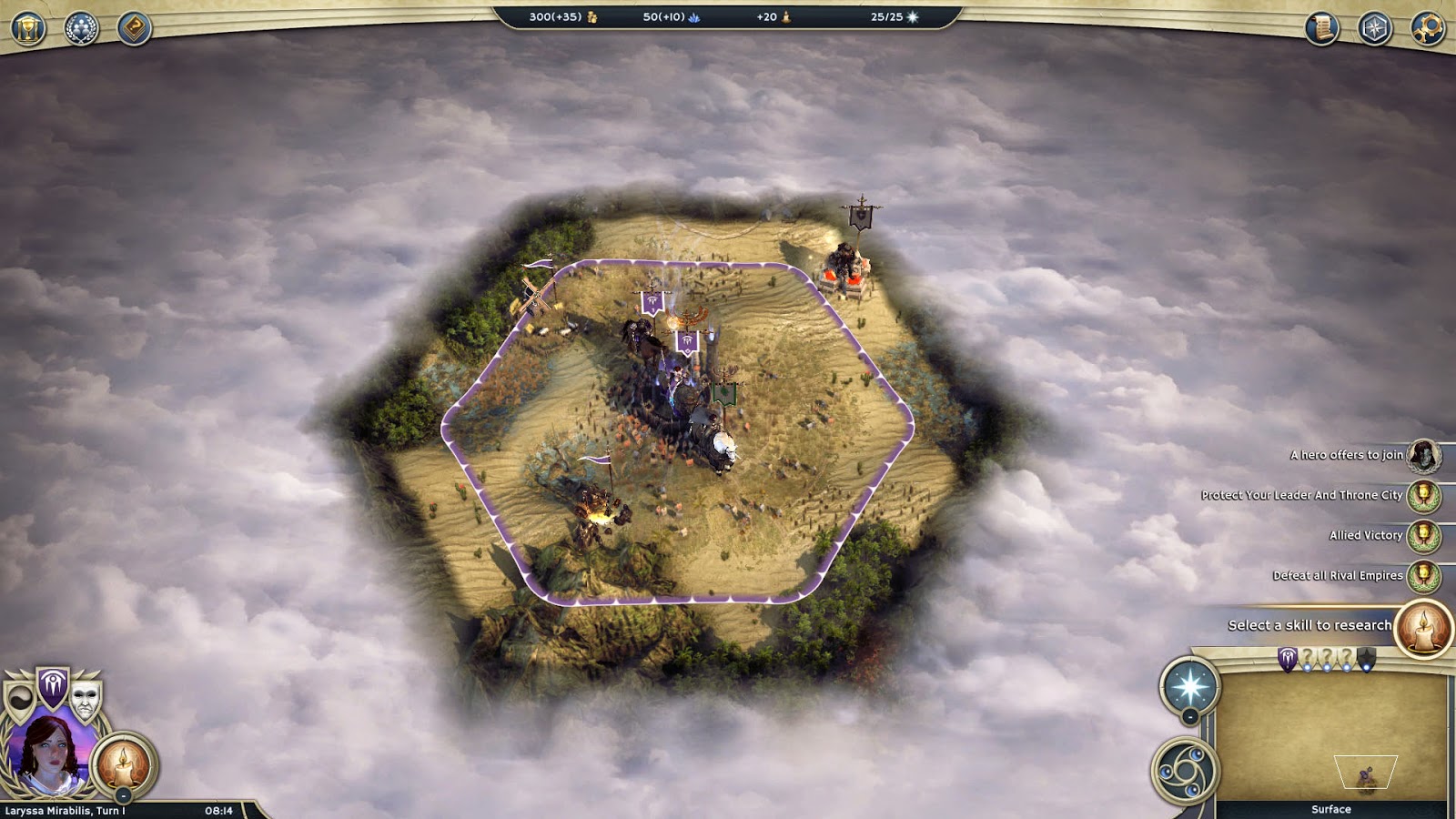
AoW3 starts as many 4X games do, right down to the clouds which obscure unexplored areas - unless you've turned off map exploration and can see the entire map. One thing AoW3 has that many other games don't is a large number of options to customize that start. Do you want to start off with a highly developed city, a strong army, and many skills already researched so you can quickly spread across the map? How about a tiny town, a weak army and no skills? How about a settler instead of a town so you can choose your starting location? You can even start with no town or settler so you have to conquer your first town. The advanced setup options lets you mix and match settings to your heart's desire. Triumph has also provided presets for those looking for some guidance. Map features and terrain types have their own set of options to adjust their frequency - or randomize things for a surprise.

I think I've been here before


Even the medium maps are quite large and provide the opportunity for much exploration, as you can see from the 'cloth map' view. Like prior Age of Wonder games, the world can also include an underground layer, accessed through caves dotting the land above.

Lots of room to explore on a medium map.
The world is attractive - lush fertile plains and forests, dry craggy mountain ranges, ice covered lands. There is a lot of visual variety to the maps, unless you've customized the settings to create a map tailoring the landscape. By default, AoW3 is pretty generous with special locations dotting the landscape. These locations may provide bonuses to cities when located within their domain (radius), generate resources, provide magic items to equip your heroes with and more.

While the maps are attractive, the caves to the underground layer can be very difficult to spot. I've gotten into trouble several times because I didn't notice a cave, until troops started coming out and attacking my lightly defended cities. They are easy to spot on the cloth map, but that requires remembering to zoom out to activate the cloth map as new land is explored. While technically you can play much of the game from the cloth map, it isn't nearly as friendly to do so as in the Fallen Enchantress series. I wish there were more choke points on the map. Practically all terrain can be traversed, albeit at different speeds. Fliers can zip around unhindered. This essentially means a player must either have troops in every city, or be very careful to visually monitor all approaches to their cities. The AI is pretty good about searching out weakly defended cities, but I never got the feeling it was doing so unfairly.

Cities are the resource centers of the empire. As the city's population grows, so does its domain. When resource locations lie within the domain, the resources are added to your coffers. Much of the early game is about defeating the guards protecting these resource locations and scouting out new places to settle cities - one with lots of resources and in terrain which will make you race happy. Happy populations grow faster and provide a boost to the economy. Gold pays for troop recruitment and maintenance, and building construction. Mana is used to cast spells, some of which require upkeep. Research unlocks abilities and spells. Economic management is pretty simple as there aren't a lot of different resources or workers to manage. I think it can use further balancing. In every game I've played, I've had more mana than I know what to do with. Gold has to be spent carefully, balancing city improvement, troop recruitment and hiring new heroes. If you don't have the funds to hire heroes when they show up, they will leave for greener pastures. It is interesting to note that even the ability to settle cities is an option that can be turned off. The world can be populated with independent cities to conquer instead of settling your own.

You won't find the type of city building options available here as you would in a game like Civilization. AoW3 is very much focused on war  and as such buildings typically exist to unlock troop recruitment, improve troops, and build walls to protect the city, although a few other types exist. You won't find anything terribly interesting or be racing to build unique wonders.

Research is also quite simple. Up to 12 items are available for research. New ones appear semi-randomly when research of the current item is complete. Gradually, more powerful options become available based on the class and specialization of your leader.

Let's Meet the Inhabitants

While there are 6 playable races, I didn't find them different enough to make playing each one a compelling, unique experience. Each race does get bonuses (or penalties) to differentiate them from the rest, but it felt very subtle. It also doesn't help that the troops of each race are very similar, just tweaks on the standard troop types - irregular, archer, infantry, pikemen, cavalry, priest and siege weapons. There are some that shake it up more than others, but as a whole I was disappointed by the lack of variety.

More variety is introduced by the empire's leader. The leader's class adds 1 to 6 other units that fit a common theme. But again, they are very similar across the different races. I do think the basic and class specific units are very well done, but they just don't have enough variety. There are also different types of creatures you encounter on the map, so that does help to spice things up.

While each empire starts as 1 of the 6 playable races, conquering or peacefully acquiring other towns can make other races available. Again, due to the lack of variety it just doesn't feel like getting a new toy to play with. The distinguishing feature is that each race has terrain types that affect its happiness. The happiness affects the productivity of its cities and the performance of its troops. Some leaders will eventually get access to spells to change the terrain of the land, or convince its population to be more accepting of a terrain type. The interplay between managing different races could have been a way to add interesting choices, but there really isn't anything in that department either.

Triumph Studios has the foundation for a very satisfying happiness (morale) system. There are global happiness modifiers that affect all cities and troops. Lose a battle? People start to get a bit unhappy. Conquer a city and your empire's happiness increases. If an enemy enters the domain of one of your cities, that city becomes unhappier. There are other factors too and they feel natural. The main problem with this system is that it has been too easy to keep everyone happy, or at least content. I only had 1 city threaten to revolt, and that was in my first game before I understood how terrain affected happiness. I have occasionally had unhappy troops, but it never had a significant impact on my battles. Again, I think it is a balancing problem.

Triumph studios did succeed in creating fun, different abilities. Many of these are a part of the units and creatures encountered in battle. Others are particular to your leader. Even the more mundane ones contribute to the overall enjoyment of the system - different damage types and resistances, being more effective against a particular troop type, healing friendly units, and more. Some units can move more easily through some terrain and even conceal themselves so they can more easily penetrate enemy lines. During the late game, it is always advantageous to have armies of the more powerful troops as long as the maintenance is affordable. Since there isn't a lot of troop variety for players,  it would be nice if the early troops could remain more relevant. If their situational bonuses were more pronounced (such as a pikeman's strength vs. mounted and flying units) it may be worthwhile to keep one in your main armies. Since units gain experience and improve, maybe offering greater leveling bonuses or raising the level limit past 5 would make these units more valuable.

Leader abilities provide even more powerful and interesting options. This is one area the game shines. If I could offer one criticism here is that some of the unit buffs are too subtle - I'm looking at you Bless. In so many cases it seems more productive to cause damage to the enemy instead of taking the time to buff a unit. Hopefully this is another balance issue that will be addressed by increasing the effectiveness of some of the spells, increasing the ability to cast spells in combat, or allow unit buffs to be cast outside of combat. Otherwise they go unused, by me anyways.

Speaking of spells, they are regulated by casting points. A leader can use a certain amount of casting points each turn. This limit can be increased through research and is one of the early areas I usually focus on. These points are shared between the strategic and tactical battles, so that can lead to some interesting choices. There are interesting and powerful creatures to summon, which helps alleviate some of the troop 'sameness'.

Expect War

There are no victory options other than complete domination. Eliminate each leader and their throne city to become victorious. If a leader is killed, they respawn in the throne city several turns later. If they don't have a throne city, then they are eliminated. In theory, this should cut down on the end game slog, but in many cases there is still plenty of slog. First, the leader and throne must be located. As I've said the maps are large. Even if the throne city is conquered, it only takes a handful of turns to build a new one. So, the leader and throne city have to be conquered within a short amount of time of each other. Sometimes you get lucky and find them in their throne city. I think there are several ways to improve that aspect of the game, such as limiting the ability to relocate the throne city to when the existing one is still under control, or requiring the leader to be in the throne city to initiate relocation.

There isn't much in the way of diplomacy, and it doesn't always make sense. This is probably the weakest system in the game. War, peace, open borders, trading and alliances are the available options. There are times where simply greasing the leader's palm with be enough to get them to like you. Other times they are disagreeable, even when they aren't as powerful. One of the impediments to a sane diplomatic relationship is how border conflicts affect the game. Cross the border into another empire's domain without an open border agreement and they start getting unhappy. Seems reasonable. If they enter your domain uninvited, then they still get unhappy. When this happens enough, they will hate you which will probably lead to war. There is no way to stop them from entering your lands other than declaring war. This hurts your relationship with others since you started the war. I would like an option to kill their trespassing units without declaring war or warn them that if they do it again they will be automatically declaring war as the aggressor. Independent cities will also declare war when first discovered for no apparent reason, they can even have a similar alignment. I'm not even going to get into the alignment system because it doesn't really make sense to be and can pretty much be ignored.

I've already said a lot, probably too much, and I haven't mentioned the tactical battles. These are clearly the main feature of the game. The basic system is simple enough. Many ranged attacks and virtually all melee attacks can be performed 3x per round. As the unit uses movement points, the number of attacks it can make decreases. Different damage types, resistances and abilities make some units more effective against others. Dictating the matchups plays a significant part of the battle. Spells can be quite powerful and easily be the deciding factor. My army has been severely outclassed, but a judicious use of spells turned the tide.


These tactical battles are the best I can remember in a 4X strategy game. Ranged attacks can't reach the entire battlefield like in Fallen Enchantress, and line of sight matters as units can take cover for extra protection. Units make attacks of opportunity on the enemy if they try to leave its zone of control. Flanking attacks inflict more damage. Powerful units feel powerful, but can be taken down if outnumbered. The AI typically makes intelligent moves in battle and finishes off units where it can. This is important because a severely wounded unit is just as deadly as one at full health. This can be confusing at the start because many units are depicted with multiple individuals that die as the unit takes damage. This is a visual effect only. I think being able to injure units to make them weaker would open more tactical options. To be fair, some attacks can make a unit weaker by inflicting a status upon them - like setting them on fire. Nobody fights as well when they're fire. I know I wouldn't.

Cities can build wooden and stone walls to keep their soldiers protected while ranged units can soften up the enemy. Ranged units gain an advantage when positioned on the walls. Other than the walls, these play out in a similar fashion. There are a couple problems with sieges. First, it seems too easy to knock down the gate and get inside - even with regular units. Second, with flying units, infantry that can climb walls, and the ability to phase to a different location, it sometimes seems too easy to get inside. Third a couple of trebuchets on the attack can rip apart the defending AI. With their long attack, sturdy defense and big damage, trebuchets can pick apart most ranged units sitting on the walls. Once the AI has decided it is going to stay put (if it has a lot of ranged units), it will typically stay there unit the ranged units are dead or severely thinned out. Hopefully Triumph comes up with some solutions, such as making trebuchets more vulnerable and walls sturdier.

One of the features of AoW3 is that armies in adjacent hexes on the strategic map participate in the tactical battles. This usually stays manageable with most battles having 1 or 2 armies per side, but towards the end of the game can really slow things down when an enemy has 5 armies defending a city. This was a bigger issue in the campaign, but still exists in some random map games. Some players may like the battles with a lot of units, but I think the battles shine when there are 6-10 units per side. I will resort to auto resolving if battles have too many units even though I hate giving up control.

The UI

I have just a couple thoughts on the UI. I noticed I didn't make a lot of notes about the UI while playing and that is a good thing. When it comes to the UI the less you notice it the better. I like to keep the overview panel open, but it covers up the leader portrait, research button, and empire happiness. It would be nice if the panel ended just above those items. I have difficulty determining where to move ranged units to in the tactical battle to eliminate the penalty for being too far from my target. There are crosshairs that are overlayed when the unit is selected, but sometimes after I move it isn't quite what I expected and I'm not sure why. Road building is very cumbersome - select builder unit, select build menu, select road, select tile and repeat.

Graphics and Sound

The visual presentation and audio are quite good for a strategy game. As mentioned above the only problem I have is with the difficult to see underground entrances.

Technical Performance

When the game was released, I experienced some slowdowns in the tactical battles as the game went on, but those were fixed in the first patch. I'm really impressed with how fast the game loads and especially the quick AI turn times, even late in the game.

My specs: Windows 7 64-bit. Intel Core i& 860 @ 2.80 GHz. 8 Gig RAM. ATI Radeon HD 7870.

In The End...

Age of Wonders 3 is an interesting mix of 4X strategy and tactical battles. Because the game is enjoyable overall and excels in some areas, the weaknesses stand out even more. I think many weaknesses are balancing issues that can be addressed, or features that can be tweaked. Triumph Studios seems in it for the long haul, so I believe they are interested in listening to suggestions and continuing to improve the game.

The game provides many options to customize the experience, so that increases the likelihood of finding a combination that works for you. One thing I don't understand, and this isn't particular to AoW3, is why don't games provide more granularity for the options. Take difficulty level for instance. Instead of offering 5 discrete levels, why not let the player adjust the resource bonuses the AI gets manually. What if the jump from 33% to 66% is too much? Let me type in 45%!! Have presets to help the user make a choice, but give the user more flexibility.

The AI seems to play a better game than most 4X games. It is rare a see a truly mind boggling move. The AI knows how to expand, seeks weak cities to exploit, and knows how to use the tactical combat system. It doesn't always seem to visit special locations on the map, because I find many areas unexplored. I'm not sure why it has been fairly easy to beat on Lord difficulty, despite getting a 33% bonus to gold and production because it really does seem to play a good game. It is probably time to increase the level to King.

For me, it is worth playing now, but isn't the holy grail of 4X gaming. I think it does have the potential to really stand out. I can't wait to see how the game is improved with patches, or content expanded with DLC. 

Sunday, January 26, 2014

Gridiron Solitaire

Version Reviewed: 1.0
What I like: The Big Play mechanic, captures spirit of football
Not So Much: Simplistic matching
Other Stuff You May Like: Games can be played quickly
The Verdict: Lots of fun for a game with simple mechanics.
About my reviews

Official site: Gridiron Solitaire

Disclaimer: This review is based on a free review copy provided by Bill and Eli Productions.

Introduction

Sometimes a guy wants to settle in for a marathon session of Civilization, Unity of Command, or <insert your game of choice>. We want to balance the needs of our nation vs. waging war to conquer new lands. Other times we want something fun, short and not too taxing on our over-worked brains. Gridiron Solitaire fits the bill. It's a card matching game wrapped up nicely in a football uniform. It doesn't try to do a lot of things, but it does manage to capture the spirit of football. Bill Harris, the game developer, compares the game to Fairway Solitaire (which I only briefly looked at). Gridiron Solitaire is purely a single player game.


Getting Started

The game is explained via some annotated screen shots activated via the help menu, and some tutorial messages at the start of your first season. It's very simple to understand, but I did need to ask Mr. Harris a couple questions to get some of the details.

Luckily we don't need to wait for a phone call from an NFL owner. We can select a team and jump right in. The chosen team essentially defines how tough we want to make it for ourselves (along with the difficulty level chosen in the options menu). Each team is rated in 5 areas. I'll get into the effects later. The teams can be renamed and colors tweaked if you're into that.


Game Play

A brief pre game announcement discusses the strengths and weaknesses of your team compared to your opponent. Then we're set for the action.


If you're observant you might have noticed in the screenshot above that it's first down and 40 yards to go. No, the Freeze weren't hit with 6 false start penalties to begin their drive. Speed of gameplay was of a primary concern for Mr. Harris, so first downs are 40 yards instead of 10 and the offense makes larger gains than usual. If you're speedy about making your card matches, a game can be completed in 15-20 minutes. I'm a little anal about making the best match, so my games tend to clock in at about 30 minutes.

Playing some D

When on defense, the first task is to defend against the run or the pass. The AI bases its calls on the down, yards to go for a 1st down, the field position, score and the time remaining. The AI will also consider its team ratings. If the player chooses correctly, the AI will make a smaller gain. The AI play calling does a pretty good job keeping the player guessing and making intelligent choices. I certainly didn't agree with every call, but did you watch any Dallas Cowboy games this season? Strange plays get called in the NFL.


The difficulty level determines how many yards the AI gets while playing offense. On veteran (medium), the AI gets 15 yards on plays where the human guesses correctly and 30 yards when there is an incorrect guess. Hmmm, doing some quick math that means the AI will gain 45 yards on 3 plays even when the player guesses correctly? Is this madness? How can they be stopped? This is where the card matching mechanic comes into play.

Cards of a different color (red or black) can be matched if they differ by 1 number. Make a match and those cards are removed with 2 new cards taking their place on the field. Red 4 and black 5, match! Black 8 and red 1, no match. For each match made, subtract 2 yards from the AI's gain. If a player averages 1 match per play, that 45 yard gain becomes 39 and may force the AI to punt or go for a field goal. If the player doesn't guess right on 1 or more plays though, there are a lot more yards to negate to prevent the AI from getting a first down. For me, the card-matching mechanic is too simple to be satisfying. There really isn't much in the way of skill or planning. Sometimes there are multiple choices for matches and some may be better strategic choices, but that is the extent of the skill needed. Mr. Harris chose to keep the matching simple to keep the pace of the game fast, but I think that aspect of the game can use more meat on it.


Sometimes the cards we're dealt just aren't enough. One could accept their fate and chose End Play, or they can use the defense's best friend - the Big Play. Usually, the Big Play will give the player an additional card to use to try and build a match. Occasionally it will reveal a text event which may offer up something big, like a turn over. If your team's defense rating is better than the AI's team offense rating for the called play (run or pass), your chance of getting a text event go up. If your rating is worse, chances for an event go down.

Now, Big Plays are limited per half so you need to ration them. Several factors determine the number of Big Plays a player receives per half - home field, weather, and your team's defensive ratings compared to the opponent's offensive ratings. Use the Big Plays up too quickly and you may be defenseless against an AI drive late in the half. This is one of the best features in the game. The Big Play adds some risk and resource management to the game and there were times I really agonized over my choice. There is no guarantee the extra card will be useful and sometimes multiple Big Plays are required to make an important stop.

Playing Offense

Like on defense, the first choice on offense is deciding whether to run or pass. If the AI chooses its defense correctly, the player has 1 less card to build a match with. For a running play, each match the player builds nets the player 4 yards. For a passing play, each match after the 2nd yields the player 8 yards. So if the player makes less than 4 matches, the running play will yield more yards. More than 4 matches and the passing play yields more yards. Of course, picking the play that the AI didn't expect makes matching easier with the extra card so it is beneficial to mix up your plays somewhat, even if you favor one type of play over the other.

Big Plays on offense work a little differently than on defense. First, they are unlimited. Second, each time you press Big Play for the current play, your chances of receiving a text event go up. Since the events are almost always neutral or negative for the player, they are better avoided. If the player's offensive rating for the play is better than the AI's defense, the chance of receiving one of those events is reduced.

The player has a bit more control over their destiny on offense. The player can take better advantage of the team rating matchup since they control the type of play. Again, balancing the advantage of getting an extra card from using a Big Play with the chance of getting a negative event provides much of the excitement.

The Intangibles

As I already explained, the card matching mechanics are one of the low points of the game for me, and I'm not usually into games with a lot of luck involved. Still, I found myself agonizing over Big Play choices, getting anxious about what cards I would get, and swearing and cheering during my game. Despite the simple mechanics and card matching I was drawn in. I haven't mentioned many of the ways Mr. Harris has added lots of little touches that add the thrill of football into the game because I don't want to ruin the sense of surprise when they happen. Just be assured there are some more of these intangibles.

The Big Show

Win enough games and your team will make it to the playoffs. In my first season, I had selected the easiest difficulty and picked the best team. This resulted in an 11-4 record and a championship victory. In the offseason, teams get the chance to improve their teams through a draft of sorts. If you sign a player, your team ratings may go up in a category. To simulate unproven players, some are more likely to go bust. If you don't sign any player in a team rating category, your team rating will degrade in that area. Poor teams get more money to spend on these players, so it is very difficult for a playoff caliber team to improve. It's a nice little touch to let the player try and take a bottom team and improve them over the years, or take a good team and try to stay  'good enough' to win back to back championships. For those who want to get through seasons quickly, the player can simulate any of their games instead of playing them out. So if you get tired of losing with a subpar team, you can quickly get to the offseason to try and sign some players to improve it.

I did continue with my team part way through the 2nd season after increasing the difficulty to medium (veteran). Between the increased difficulty setting and not getting a lot of money to improve my team, it was harder to win with the same frequency. I also started a game leading the worst team in the league on veteran difficulty and I only won 5 games.

Some Suggestions

There are a couple of things that I think would improve the game. I wish that the maximum yards the AI can get on offense had some variability to it, based on the team ratings. Knowing that the AI will get 15 or 30 yards, less due to any card matches made did take away from the excitement at times. Also, it is very hard to stop the AI from scoring a touchdown if they get 1st down within the 20 yard line or so. It should be difficult, but in my experience it was pretty hopeless since they are going to gain 15 or 30 yards per play, less any card matches. In real football it is harder to move the ball in the red zone; it would be nice if the Gridiron Solitaire reflected that. Forget making a goal line stand unless you use a lot of Big Plays.

Graphics and Sound

Gridiron Solitaire has some simple, but clean graphics that are fitting to the game. Personality is injected here and there. It works, but this isn't really a game about eye candy. The 'personality pieces' never really take up a lot of time, but it would be nice if we could click through them after seeing them a time or two.

Technical Performance

The game performed flawlessly without any crashes or hiccups.
My specs: Windows 7 64-bit. Intel Core i& 860 @ 2.80 GHz. 8 Gig RAM. ATI Radeon HD 7870.

In The End...

I didn't really have any expectations going into Gridiron Solitaire. I knew a little about it, but none of the details. For such an abstract representation of football, it does a great job at capturing the flavor. This is one of the more enjoyable games I've played for a game with such simple mechanics. While I thought the matching mechanics were too simplistic, managing the Big Plays was great fun. I was getting excited both when things did and didn't work out for me. Bill Harris included so many little touches that just tickled my shoulder pads - not the hideous 1980s women's shoulder pads, but the cool football ones.


Mr. Harris does have plans to continue to improve the game, but I don't have any details about what may be included in the updates.

If you sometimes like to relax with a more casual game and don't mind games with a good chunk of luck, consider purchasing Gridiron Football. 


Tuesday, November 19, 2013

Pandora - First Contact: Review

Version Reviewed: 1.0.2
What I like: Randomized and optionally hidden tech tree. Different take on city management. Very stable and quick AI turn times.
Not So Much: Poor manual only contains lore. Some features are a little light.
Other Stuff You May Like: Multiplayer
The Verdict: A solid entry into the 4X genre. While there is room for improvement this is a very good first version which can be enjoyed right out of the box. I hope the developers take it even further!

About my reviews

Official site: Pandora: First Contact

Disclaimer: This review is based on a free review copy provided by Slitherine / Matrix Games.

Introduction

Once upon a time, in a land far, far away, there was a game called Alpha Centauri. Lots of people loved Alpha Centauri and Firaxis was happy. I haven't played it in well over a decade and don't remember the details of the game so this is where Alpha Centauri's appearance ends, other than being an inspiration for Pandora: First Contact. For those of you who don't reside in the Milky Way (Hey, nothing ever disappears on the internet. There may be readers outside the Milky Way in another 1000 years!), Pandora is a 4X game set on an alien planet. It plays similarly to a game like Civilization and contains most of the usual 4X trappings, while adding a couple new twists of its own.

Getting Started

Well normally I would say read the manual to start off, but since the manual only contains lore I would say you are free to skip it. I did. In general, I don't feel the need to read the lore about a game. Sometimes I read the flavor text within games, but I want to play the game. I wouldn't object to the lore being in the manual if the manual actually contained the instructions on how to play the game, but it doesn't. There are some helpful hint messages that pop up when encountering new aspects of the game and tooltips that go a long way to peer into the mechanics of the game, but they aren't enough to answer all questions.

Pandora contains the basic options one would expect when starting up a 4X game - world size, land formations, difficulty, pace of research and production, along with a couple more, but they are a little on the light side. There are only three types of maps - pangea, continents, and archipelago. There are 6 factions to choose from and no ability to create a custom faction. Each faction does feel different due to some pretty substantial bonuses, which somewhat steer the player towards a particular play style. This isn't to say you are  completely locked into playing a specific way, but there isn't as much flexibility as with Civilization.

While the bonuses do differentiate the factions pretty well, there aren't the other trappings players of Civilization have come to expect, like faction specific buildings and units.

Note: The game does provide simultaneous turn multiplayer, but this is only a review of the single-player aspect.

Game Play

The following should be familiar to any player of 4X games. Each faction starts on a shrouded map, ready to place their first city. It's so familiar I think I may have typed the exact sentence in a previous review.


The Economy

Pandora puts a twist on the tried and true Civilization model of city management and the economic game. Instead of assigning people to one of the city's surrounding terrain tiles, they are actually assigned roles. Farmers and miners work the land to generate food and minerals. When a person is assigned to be a farmer or miner, they automatically work the most productive portion of a terrain tile that pertains to their job, since a tile is capable of yielding food and minerals. Food and minerals are placed in the faction's stockpile to be used by any of its cities. This really makes sense for a space age game since one city should be able to ship resources to another city.

Cities don't increase in population by accumulating excess food. There is a natural growth factor. As the city's population grows, so does the growth rate. This is logical because when there are more people, there are more people making babies. For those people to survive, you must be generating enough food to feed them, or have enough in the stockpile to draw from. This feels more natural then the excess food method of growth and I rather like it. I do wish there were other factors that affected a city's growth rate, as this is a little too simplified.

When people are assigned the worker role, they generate production used to produce units and buildings. Each unit of production needs 1 mineral; otherwise the production capacity is decreased. People assigned to the scientist role generate research to give access to more advanced buildings, units, and more.

Would the toolbox of any planetary ruler be complete without a slider to adjust the tax rate? I think not! Setting a higher tax rate generates more credits, but at the expense of the city's morale. Credits can be used to speed up production, pay for building and troop maintenance, and grease the palms of other rulers' to buy their friendship.

Now all these workers doing their thing generate pollution; workers the most and scientists the least. Pollution makes people unhappy and reduces the city's morale. Not having enough housing also makes people a bit cranky. Morale has an effect on the productivity of the city's workers, so you don't want them to be unhappy for too long. One cool thing about morale is that your people will automatically migrate from cities of lower morale to those with higher morale. I've never really had to pay too much attention to it as something to manage, but it is cool nonetheless.

All of this is pretty easy to understand due to the tooltips, but I'm sure a manual would be of use to many people trying to learn the game.


The Lay of the Land

One aspect of Pandora that falls a little short is the terrain tiles. While there are some special locations that give different bonuses, there aren't any special resources to get excited about. One of the fun things in Civ is to find a source of a special resource. Pandora doesn't have any luxury resources or strategic resources. For those who don't know, strategic resources are needed to build certain units in Civilization. This makes acquiring enough of a supply a high priority and fuels the desire to trade and make war. Luxury resources are used to boost the mood of your peoples. Pandora feels a little flat in this regard since it doesn't have either, or something else to pick up the slack.

A Sense of Discovery

So the scientists are busy at work generating research and not before long they will discover one of the 100+ technologies. Researching a technology unlocks things that make your faction better in some regard - new buildings to construct in your cities, types of military units along with components to equip them with, general perks that immediately help your faction, and best of all ... operations. There are three features that make the Pandora tech tree stand out from many other strategy games. The locations of the techs in the tech tree are randomized, so the player doesn't always research the same techs in the same order. This presents fresh decisions each game instead of falling into the same pattern. Secondly, the visibility of the technologies can be limited to 0-3 techs beyond the ones currently available for research. This adds an element of surprise and discovery to every game. You just don't know what technology will be revealed further down the tree when you discover a new one. This forces the player to adapt somewhat the hand he is dealt. There is still some opportunity for planning depending on the option controlling how many techs get revealed. For those not feeling that adventurous, the entire tech tree can be revealed right from the start, but I think that would take a lot away from the game. The third feature is a little more subtle. There are multiple paths through much of the tech tree, so some techs can be bypassed entirely. Discovery could lead deep down one path without expanding another. This leads to interesting decisions about whether to try and make a beeline for more powerful technologies, which may take a while, or discovering the closer ones that provide a more immediate effect. There is a drawback to this randomization; the techs don't always progress logically through the tree - satellite reconnaissance leading to better recycling? It is a small price to pay for a set of features that adds much to the game.

Most of the technologies feel pretty typical for a 4X game, but where Pandora hits a home run is with the operations. Discovering an operation technology either unlocks a building or item that can be constructed. Once the building is built, its operations automatically generate every 'x' number of turns. Item-based operations are generated each time one of the cities produces the corresponding item. Operations are one of the highlights of the game and range from reconnaissance, unit repair, long range troop deployment and more. By 'and more' I mean some incredibly destructive weapons. Once acquired, select the operation, the target and watch the results.

I've seen the AI use some of the operations, but not others, and not with the frequency I use them. There is one operation that allows troop training, making them more effective in combat. It comes early in the game and performing it multiple times on a stack of troops really can boost their strength. I use them a lot, but I haven't noticed enemy troops with a very high level of training. Its liberal use should be a no brainer.


Some people may view this as a plus, but I think the pace of research is too fast. Even during the end game it isn't unusual to research a new tech every 1-4 turns. This can be tweaked with the pace setting, but that also affects production speed. Separate settings would be appreciated.

If You Build It They Will Come

What 4X game would be complete without the ability to build structures in your city to give various aspects a boost? If I counted right, Pandora has 36 such buildings. Most of them improve one aspect of the city's performance - troop strength, mining, farming, living quarters, pollution, research, production, morale, and tax income. They come in flavors of increasing strength as research progresses further down the tech tree. They are useful, but not too exciting. The lack of 'wonder buildings', like in Civilization, is sorely missed. The race to build my favorite wonders is one of my favorite parts of games like this. It is hard not to compare 4X games to Civilization.

The Big Stick

A 4X game isn't complete without some military conflict. In the early and even the mid game, the native life forms can be a threat. Of course there are the other human factions, who if not mollified can be a thorn in your side. Depending on the setting, the alien life forms may remain peaceful for a while or want to show you the door in a hurry.

Units are made up of 4 parts - the base class, weapon, armor and device. The class defines the base capabilities of the unit - infantry, tank, mech, boat, and plane. Weapons can only be equipped on particular types of units and may be tailored to combat certain unit types more effectively, or have some other perk to them - such as splash damage. Armor adds to the overall strength of the unit, making them more effective in most situations. Devices also modify the abilities of the unit giving them perks such as being more effective on offense or defense, able to see farther, attack multiple times per turn, and more. It combines into something a somewhat more complex than the typical rock, paper scissor system found in most 4X games. You won't get very far if you don't design your own units since the default ones are bare boned. Luckily it is a simple system to use and new designs can be created in less than a minute. I'm not a big fan of unit customization in general, but I didn't find this implementation too cumbersome. The unit workshop could be improved if it allowed the player to specify 'best available' for each option to reduce the amount of unit redesign as techs are discovered.


Units are rated for power (how effective they are at causing damage), speed (tile movement per turn), sight (how many tiles they can see), health (their current condition), and rank (combat experience). While units can be stacked (yea!), combat occurs between two units. This can make for some lengthy battles when besieging a highly defended city, but it is better than Civ V's 1 unit per tile limitation in my opinion. Stacks are susceptible to splash damage attacks, so that is something to consider before putting all of your eggs in one basket.

Pandora is lacking an interesting unit promotion system. As units gain rank, they are more effective in combat but don't acquire any special perks that can help make them unique.

The AI is capable of launching dangerous attacks on the player. It took me 4 games at the default difficulty setting before I achieved my first victory as I was wiped off the map in 2 of my first 3 games. Even after I got the hang of the game the AI would threaten and sometimes capture my cities. While it certainly performs better than the Civ V AI in terms of combat, it does sometimes attack a city with forces that don't have a lot of hope of winning. The AI also tends to keep a lot of the early game units without upgrading them. So there are some areas for improvement to up the challenge for the human player. The AI also can become predictable with their attacks, repeatedly going for the same city or two.

A helpful combat window is displayed to show the applicable modifiers, along with the suspected victor and casualties inflicted.


Diplomacy

Diplomacy isn't horrible, but it is perhaps the weakest area of Pandora. The standard diplomatic options exist - non aggression pacts, map trades, economic and research treaties, alliances and declaring war. Greasing a faction leader's palm with some credits may buy some friendship for a while. Some factions are more predisposed to combat than others. It seems like the religious fanatics are the most trigger happy, followed by the militaristic one. With some effort you can keep almost everyone happy with you, but at the cost of how many credits? Factions will also demand tributes if they feel they have the upper hand, or offer gifts when they want to cement their friendship. There is also the cheaper option of just praising another faction to try and boost your friendship. It all feels very Civ Vish. While it is easy to see who likes you and who doesn't, it isn't clear as to why they do. I have no idea if close proximity affects the likelihood for hostilities or what factors are involved. The factions generally don't behave too crazily, flipping from friendly to aggressive, but there was a little of that.

After having a long time friendship with a faction, I decided the time had come for their land to become mine. I terminated my agreements and waged war. This didn't seem to have an effect on my relations with any other factions. It seems like if a faction attacks another faction that they are still friendly with, other factions should deem them less trustworthy. Then you can decide to take more time decreasing your relations by using the renounce feature so relations with your other friends aren't harmed, or attack quickly but at the cost of being viewed as deceitful.

It would also be nice if resource trading between factions was allowed, giving another motivation to have non-hostile relations.

Graphics, Audio and UI
So while Proxy Studios dropped the ball on the manual, they slam dunked the user interface. The main screen is uncluttered; important information is typically clearly displayed, events of interest each turn are displayed on the right and jumping to their source is just a click away. Research, production, and unit movement reminders are displayed prominently adjacent to the next turn button. Tooltips fill in most of the blanks. An economy window provides a sortable list of cities which can be managed right from the list. The diplomacy screen shows your relations with all of the discovered factions, the relative strength of each pertaining to their economy, military, research and diplomacy. My one complaint about the diplomacy screen is that the criteria used to judge the factions in each category aren't explained at all. I attacked and trounced factions that were ranked stronger than me militarily, so I think the rankings may heavily weigh quantity over quality. The criteria for the other categories aren't obvious either. The progress for the victory conditions is hidden away as tooltips for the corresponding tabs at the bottom of the screen. It took me a while before I stumbled across that.

The game does provide some popup messages for big events, such as a faction discovering nuclear weapons and black hole generators, or getting close to victory. Unfortunately for me it wasn't clear what the impending victory messages meant until I lost. Now that I know what they mean it isn't a problem.

The UI could also be improved by allowing the reordering of the build queues in each city. As it stands, to add an item to the beginning of the queue one must remove all of the existing items and then add the new item.

The graphics are good, but at the zoom level one is likely to play at some of the detail is lost. Zoomed in it is easy to see what type of weapon a trooper is carrying, but less so when zoomed out. The UI just gives it a clean crisp look that does its job and is pleasant to look at. I have no complaints.

The music was kind of forgettable to me, but this really isn't a drawback for me. It wasn't obnoxious or anything, just neutral. Really good music is more of a bonus than a requirement.

AI

I've already mentioned the AI several times throughout the review, but I'll sum it up here. The default difficulty AI easily provides a challenge when learning the game and can be given more bonuses as your skill increases. It can put together successful attacks, but sometimes doesn't bring enough force. It does mix up its forces to some extend too. I don't think it quite knows how to take full advantage of some of the operations. City development seems reasonable, but they will squeeze an occasional city into pretty poor terrain.

Technical Performance

The game performed flawlessly without any crashes or hiccups. Even alt tabbing out while writing my review was smooth and caused no issues. Another item to note is that AI turn times were fast. Even late game turns passed by in a matter of seconds. In Civ V I would guess turns can take 5 times as long.

My specs: Windows 7 64-bit. Intel Core i& 860 @ 2.80 GHz. 8 Gig RAM. ATI Radeon HD 5850.

In The End...

After rereading my review I seemed a little down on Pandora, but as a whole that isn't the case. Pandora: First Contact is a very solid 4X offering, following many of the conventions of the 4X genre but adding enough of its own touches to make it feel like its own game. Research and the tech tree are strengths for me, along with operations. Operations almost make me forget about the lack on wonders, but not quite. If Pandora could add more techs that weren't simple, improve economy / production / morale / etc by X amount, research would be even more interesting. And add some wonders! I enjoyed having to learn a different take on the typical growth / production model of 4X games. Growth in Pandora feels more natural than the accumulate food method. I do wish it was a little more sophisticated, perhaps tie morale into the growth equation and have more things affect morale. Living in a city that is attacked should lower morale. Who works as productively when the threat of invasion is looming overhead?

The combat system is simple, but offers many combinations of forces with an easy to use unit designer. Because the designer is so easy to use it isn't a hassle to try and tailor your units to your intended targets.

Most of my complaints come from either missing some of the 4X staple features, wishing some of the systems were made a little more complex, or pertaining to game balance. I've made a number of suggestions in the game's forum. The developers have stated they are in this for the long haul, so I think the game will get improved with time. I think all of its weaknesses are fixable and they have a very solid base from which to build on. Pandora: First Contact is easy to recommend now and may get even better.

Edit 11/22/2013: I would like to add that I think the ability to produce wealth to obtain an economic victory is overpowered. Late in the game I was behind militarily. I moved most of my scientists to workers and produced wealth. I made 4-5% progress towards economic victory per turn. The AI continued to give me gifts even after I passed the 75% mark. Since 1 faction had black hole generators, they may have been able to wipe me from the map if they had enough time to break the non aggression pact and wait for the cool down to expire.